Privane Developer Ecosystem
Reason locally. Execute globally.
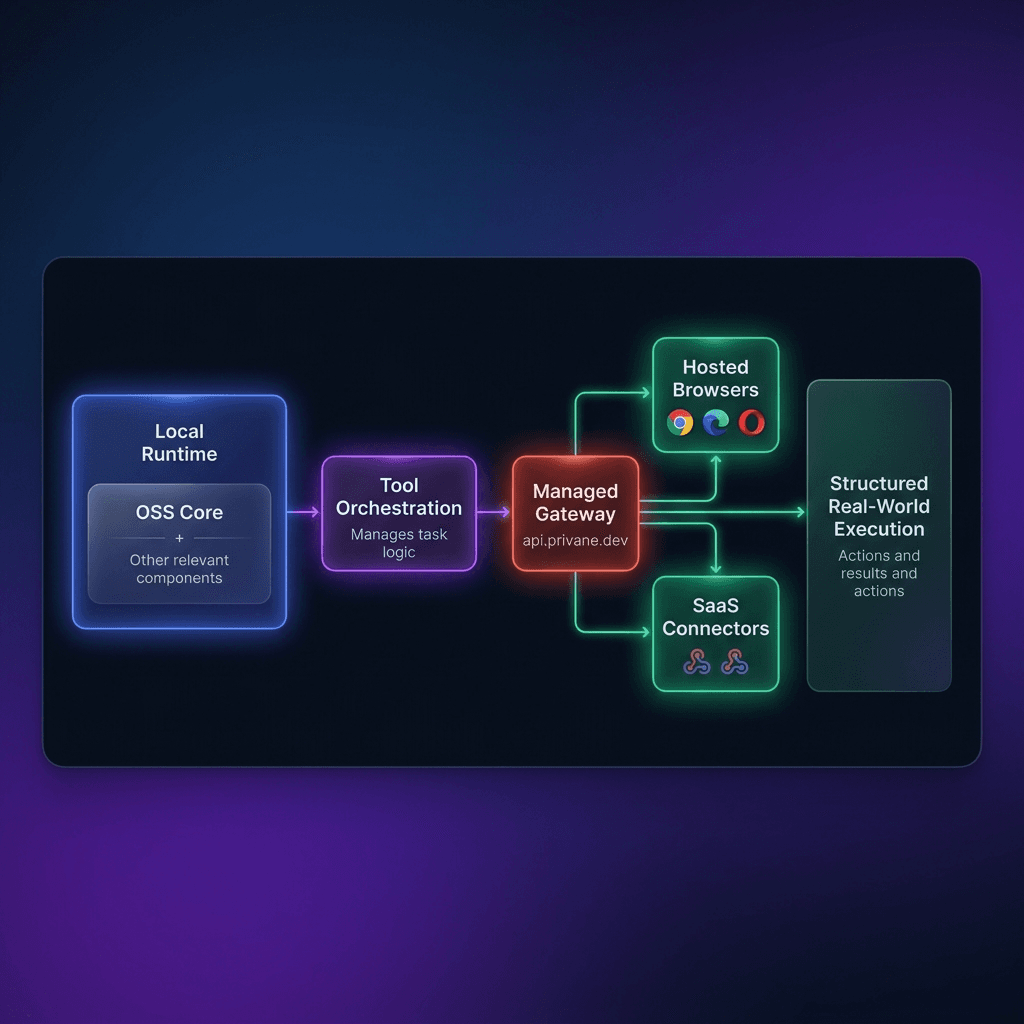
Privane is the execution infrastructure for sovereign AI. It enables developers to run reasoning loops locally while securely connecting to the real world through managed, high-performance execution gateways.
Why Privane Exists
AI agents should not require sending raw corporate reasoning, sensitive database queries, and private personal context to centralized commercial cloud providers.
Privane solves this by providing a clean, decoupled execution fabric: keep intelligence localized on secure local silicon, and route outbound real-world actions through secure, managed infrastructure.
The Master Ecosystem Strategy
To accelerate developer adoption while building a robust, enterprise-grade business model, the Privane ecosystem is structured into three permanent layers:
1. Privane OSS (GitHub & npm)
Our distribution, developer trust, and adoption engine—100% open-source and free.
- @privane/engine: On-device GGUF model loader and fast WebGPU streaming inference runtime.
- privane-cli: The local developer daemon (
privane serve) exposing standard OpenAI-compatible endpoints. - Local Tools & Sandbox: Traversal-proof filesystem and query-injection-guarded SQLite execution blocks.
- SDKs & example agents: TypeScript, Python, and edge mobile interfaces along with public examples like the
github-slack-agentworkflow.
2. Privane Cloud (api.privane.dev)
Our proprietary monetization engine, handling scaling, reliability, and security.
- OAuth Infrastructure: Safe, stateless credential mapping, secure session scopes, and refresh handling.
- Managed Connectors: Instant SaaS dispatch handlers for GitHub, Slack, Gmail, and Salesforce execution.
- Hosted Browser Clusters: Anti-bot, proxy-rotating headless Chromium node orchestration.
- Structured Browser Engine: Real-time DOM optimization and accessibility tree pruning.
- Analytics & Metering: Operational tracing, billing engines, and usage analytics.
3. Privane Hub
Our hybrid ecosystem registry—connecting custom MCP servers, templates, and triggers.
- Registry marketplace: Connectors and tool scripts packaged like npm.
- Pre-built Templates: PR reviewers, Slack standup synthesizers, and database query synthesizers.
The Single Most Important Boundary
Privane enforces a clear, psychologically perfect boundary separating local capabilities from cloud-metered routes:
| Feature / Capability | Execution Context | Requires API Key? | Why |
|---|---|---|---|
| Local LLM Inference | Client Device | NO | Local GPU/CPU computation is 100% free |
| Local FileSystem / SQLite | Local Sandbox | NO | Direct system calls remain on user hardware |
| Local Orchestration Loops | CLI Runtime | NO | Developer logic executes in offline workspace |
| Standard SDKs & Interfaces | Local Workspace | NO | Core packages are open-source and free |
| GitHub Managed OAuth | api.privane.dev | YES | Managed token handling & cloud-side execution |
| Slack Webhook dispatches | api.privane.dev | YES | Outbound API security and proxy gating |
| Hosted Browser Node | Managed Cluster | YES | Managed browser clusters and DOM pruners |
| Ecosystem Orchestration | Gateway Routing | YES | Distributed routing & rate-limiting protection |
Our Actual Moat: Normalized Execution Infrastructure
LLM intelligence, WebGPU loaders, and simple agent framework loops are rapidly commoditizing. Privane’s real moat is normalized execution infrastructure.
By building standard interfaces for auth storage, cloud browser clusters, accessibility-based DOM pruners, and persistent secure session routing, we solve the actual operational engineering friction of running reliable software agents.
How it Works
The canonical architectural layout outlines how the different open-source and proprietary components of the Privane developer operating system interact to deliver safe, low-latency, and zero-leakage agent orchestration: